


.svg)


Best Practices
Financial Higher Education Software That is Exceptionally Good With Ellucian Banner
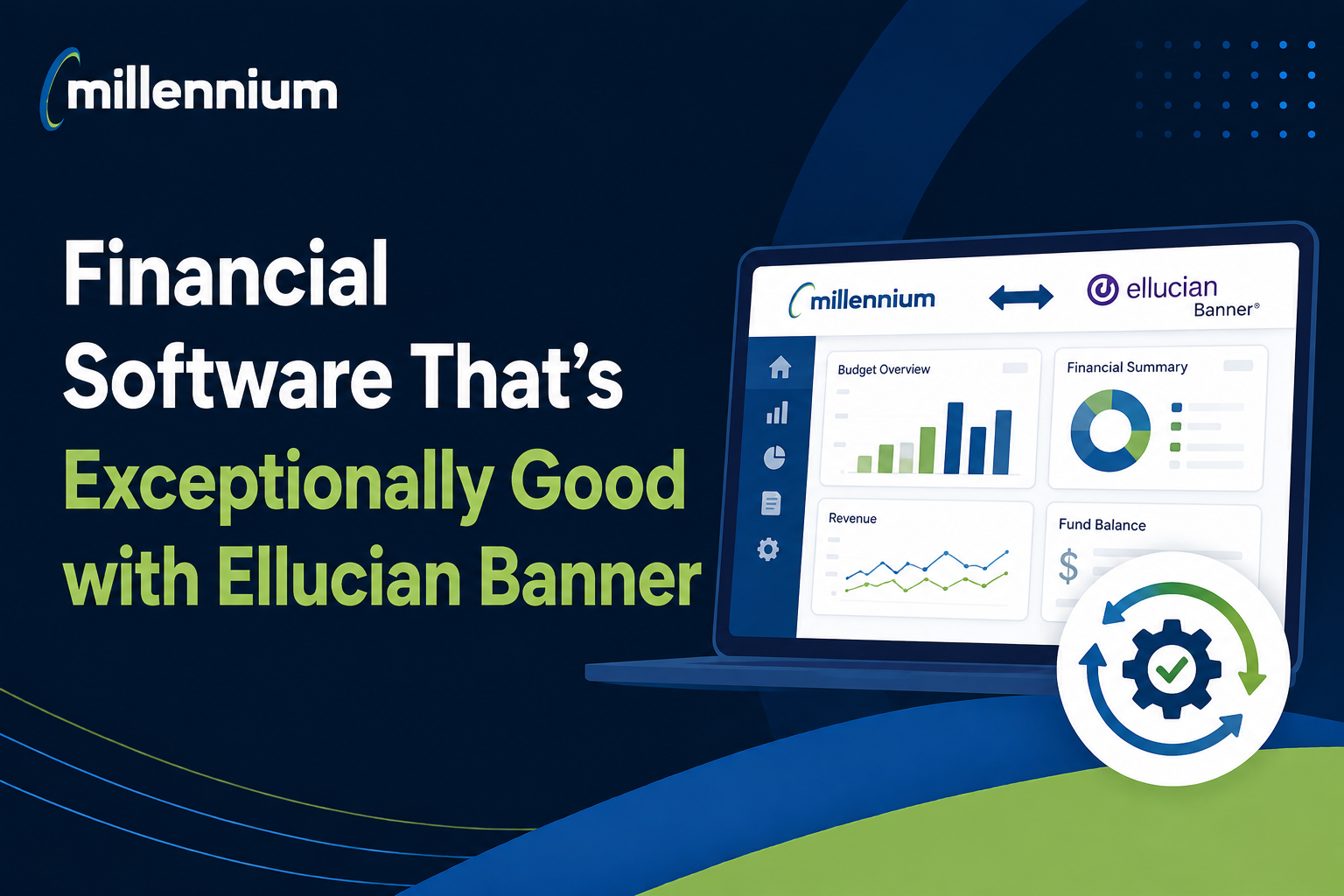
A controller's office closing out a fiscal year rarely has trouble finding data. Banner has the data. The trouble is getting it out in a form an auditor, a trustee, or a dean can actually use before the deadline passes. That gap between what Banner stores and what a finance office needs to report is exactly where financial higher education software earns its keep, and it's the problem Millennium has built FAST around since 1996.
Real-Time Financial Reporting Straight From Banner Finance
FGIBDST tells you where a fund stands. FGITRND tells you how it got there. Neither form was built to hand a vice president a consolidated operating statement across forty cost centers, and running them one fund at a time isn't a reporting strategy, it's a queue.
FAST Financial Reporting pulls live from Banner Finance to generate Operating Statement, Balance Sheet, and Trial Balance reports that reconcile the way an auditor expects fund accounting to reconcile, with the same GASB 34 and GASB 35 net position classifications the institution already reports under. Because the connection is real-time rather than a batch extract run overnight, a dean checking a departmental balance on Thursday afternoon sees Thursday afternoon's numbers, not last week's. Deans, directors, and department chairs get that view without a ticket to IT or a call to the controller's office, which is the same decentralized-access principle NACUBO has pushed institutions toward as fund accounting has grown more complex. Millennium's clients, from Queen's University to Idaho State, run this reporting across more than a million students and 20 million report deliveries a year without adding headcount to run it.
See FAST Financial Reporting for the full module breakdown.
Budget and Forecasting That Doesn't Stop at One Fiscal Year
FGABDST and FBABDST show a budget manager the current year. They don't show what happens if enrollment softens two years out, or what a 3% salary pool increase does to five departments simultaneously. That's a planning question, and Banner's native budget forms weren't built to answer it.
FAST Budget and Forecasting adds multi-year planning and what-if scenario modeling on top of the same Banner budget data, letting a budget office run tuition, fee, and payroll projections side by side instead of reconstructing each scenario from scratch. Campus-wide decentralized budgeting means department heads build and submit their own line items directly, and the finance office reviews consolidated numbers rather than chasing down each unit individually. It's the kind of scenario planning institutions have historically gone to Hyperion or Adaptive Planning for, minus the implementation overhead those platforms carry when a Banner shop doesn't need enterprise-wide ERP replacement to get there.
Learn more about FAST Budget and Forecasting.
Where HR Data Becomes a Financial Liability
GASB Statement 101 changed how institutions have to account for compensated absences, and it's a good example of why finance and HR reporting can't stay in separate systems. Under GASB 101, an institution now recognizes a liability for leave an employee has an unconditional right to be paid for in cash, whether or not that leave has actually been used, which means the balance sheet depends on accurate, current leave accrual data sitting inside Banner HR. NACUBO's coverage of the standard walks through why this recalculation caught some institutions flat-footed when it took effect for reporting periods beginning after December 15, 2023.
FAST Human Resource Reporting pulls position control, FTE, and leave accrual data directly from NBAJOBS, PEAEMPL, and NHIDIST, the same forms an HR director already relies on for headcount and salary analysis. Because that data feeds into the same reporting environment as FAST Financial Reporting, the compensated absences liability an auditor asks about doesn't require a manual handoff between the HR office and the controller's office to reconcile. The GASB pronouncement itself is the authoritative source institutions should be working from as they document their implementation approach.
See FAST HR Reporting for how position control and leave data are structured.
Revenue Visibility Before It Hits the Ledger
Tuition and fee revenue is the largest line item on most institutional operating statements, and it's usually the least visible until registration closes. FAST's Enrollment Forecasting and Planning tool models projected tuition and fee revenue from enrollment trends before the term starts, giving a budget office a working revenue number to plan against instead of waiting for the official headcount snapshot. That's a narrower use case than full student lifecycle reporting, but it's the piece that connects enrollment directly to the financial forecast a CFO has to present to the board.
Deployed Without Adding to IT's Backlog
None of this matters if it takes a six-month implementation and a dedicated server to stand up. FAST is 100% web-based, with upgrades managed by Millennium on a six-to-eight week cycle rather than left to an institution's IT staff to patch and maintain. For a Banner admin already maintaining upgrade compatibility across dozens of custom reports, that's the difference between adding one more system to support and adding one more source of self-service reporting that doesn't generate new tickets.
Financial higher education software is worth adopting only if it makes the institution's own Banner data easier to trust, not harder to reconcile. That's the standard FAST has been built against for almost thirty years, across finance, budget, and HR reporting that stays connected to the same source system instead of drifting into separate silos. See FAST in action to walk through how it maps onto your own Banner environment.


Similar posts

FAST is completely customizable,
easy to set up, and fully integrated.
Let's Talk

